Subterranean termites account for roughly 95% of all wood-destroying insect damage across North Texas. In communities like Phillips Creek Ranch, Newman Village, and Starwood, post-tension concrete slabs sit atop…
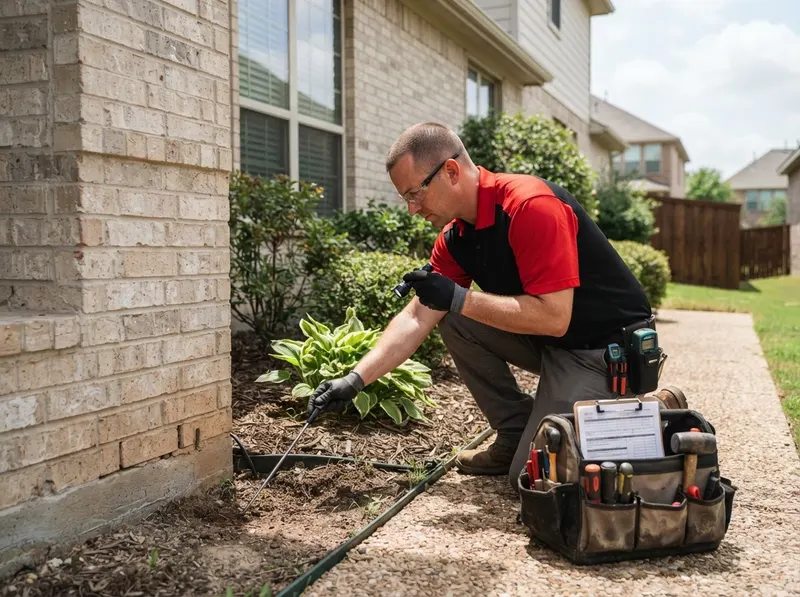
Subterranean termites account for roughly 95% of all wood-destroying insect damage across North Texas. In communities like Phillips Creek Ranch, Newman Village, and Starwood, post-tension concrete slabs sit atop Houston Black clay. This heavy vertisol soil swells in wet springs and contracts during 100-degree summer dry spells, pulling away from concrete slabs and creating hidden fissure networks. Termites exploit these sub-slab soil expansion gaps to travel upward unnoticed, building subterranean mud tubes across foundational perimeters, bath traps, and interior expansion joints. A clinical inspection targets these vulnerable entry nodes rather than relying on indiscriminate chemical spraying.
Technicians systematically examine structural perimeter zones along stone veneers, synthetic stucco, and landscape beds where organic mulch touches wooden structural elements. In neighborhoods such as Stonebriar, Chapel Creek, and The Trails, homes bordering creek tributaries and greenbelts encounter persistent moisture gradients that sustain Reticulitermes colonies. An evaluation maps moisture readings in drywall adjacent to second-story showers, sounds timber members in crawlspaces or attics, and measures weep-hole clearance against grade levels to determine whether subterranean foragers have breached the interior wall envelope.
Choosing between a standard preventive inspection and an active damage assessment depends on visible evidence. Homeowners noticing mud tubes along exterior brick ledges or discarded swarm wings near window sills require immediate targeted core drilling or trench treatments. If structural timber remains undisturbed and no active foraging galleries are present, routine baseline monitoring protects property investment without applying unnecessary termiticides near domestic pets and ornamental landscaping. The trade-off centers on upfront diagnostic rigors versus the compounding cost of repairing hidden structural sill-plate damage later. 1. The inspection begins with a perimeter transit measuring grade clearances and ground-to-brick contact. 2. Technicians scan interior wet walls and plumbing penetrations using calibrated non-invasive moisture meters. 3. Crawlspaces, garages, and accessible roof timbers are inspected for structural timber hollows. 4. An itemized structural finding report is delivered outlining specific biological risks and localized treatment recommendations.
Every job gets a firm, written price after a free on-site visit.
Tell us about your termite control inspection job in Frisco and we'll send a clear, written quote, usually the same day.
 Prairie Fox Pest Control